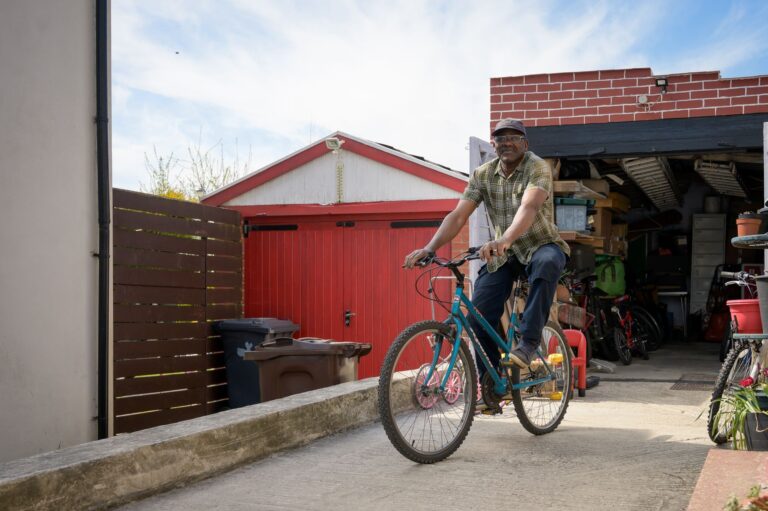
Building a cycling routine around a busy work schedule means anchoring rides to fixed points in your week — a commute, a lunch break, one weekend long ride — rather than hoping free time appears. The routine survives because it asks for a specific, small time slot instead of an open-ended one. Most cyclists who stop riding don't quit because they dislike cycling; they quit because the routine depended on finding a free afternoon that rarely came. A schedule built around existing anchors needs no extra willpower to protect, because the ride is already attached to something you do anyway.
Table of Contents
- Start With the Time You Already Have, Not Time You Hope to Find
- How Much Riding Actually Fits a Work Week?
- Where the Indoor Trainer Fits
- What to Do When a Week Falls Apart
- Fitting Strength and Recovery Into the Same Schedule
Start With the Time You Already Have, Not Time You Hope to Find
The most reliable cycling slot is the one that replaces an existing task rather than competing with it. A bike commute swaps for a car or transit ride you were taking regardless, so it costs no new time on the calendar — only the difference between modes. If commuting by bike isn't practical, look for other fixed transitions in the day: riding to a gym, to a coffee shop before work, or home from an evening errand.
These slots work because they're tied to a destination and a deadline, so they don't get silently skipped the way an unscheduled "ride sometime today" does. Unscheduled time is the first thing a busy week claims back. Treating a ride as an appointment — written into the same calendar as meetings — protects it the same way a meeting protects itself: by having a start time someone else is expecting you to honor, even if that someone is just your own morning plan.
How Much Riding Actually Fits a Work Week?
Three short rides and one longer weekend ride is a realistic structure for someone balancing a full-time job. Two or three weekday rides of 30-45 minutes build and maintain fitness; a single longer ride on a day off adds the distance and time-in-saddle that weekdays can't accommodate.
This structure works because it front-loads consistency over duration. Four 30-minute rides a week beat one two-hour ride and three missed days, because fitness responds to frequency and the body adapts to load spread across several sessions rather than one. A weekday ride doesn't need a route or a destination beyond "out and back for 20 minutes." The goal on a work night is turning the pedals, not covering ground — distance and intensity belong on the day with more time available.
Where the Indoor Trainer Fits
A trainer — a stand that turns a regular bike into a stationary one — solves the problem of daylight and weather removing your only open slot. A 6 a.m. trainer session before work happens regardless of rain, darkness, or ice, none of which is true of an outdoor ride at the same hour in winter.
Trainer rides also compress well: a structured 30-minute session with a few harder efforts delivers more fitness benefit per minute than an easy outdoor ride of the same length, because the effort doesn't depend on traffic lights, stop signs, or terrain. That makes a trainer a practical substitute on days when 30 minutes is all that's available. The tradeoff is that a trainer session requires its own short setup and teardown — moving the bike, warming up the room, showering immediately after — so it needs roughly the same buffer around it as a quick outdoor spin. It replaces the weather problem, not the time problem.
What to Do When a Week Falls Apart
A missed ride is a single missed ride, not a broken routine, as long as the next scheduled slot still happens. The habit that fails is the one where a skipped Tuesday turns into "I'll restart next week," because next week faces the same conflicts that caused this week's miss.
When a work crunch eats most of the week, drop duration before dropping frequency. A 15-minute ride keeps the habit's shape intact — the same days, the same time slots — while a full week off resets the routine back to needing willpower to restart, rather than momentum to continue.
- Keep the commute or short ride even during a heavy week; cut the weekend long ride first if only one has to go
- Treat a missed session as data, not failure — note what conflicted and move that slot if it keeps happening
- Rebuild from the smallest version of the routine (one short ride) rather than trying to resume the full week at once
Fitting Strength and Recovery Into the Same Schedule
A cycling routine built around a job also needs to account for recovery, since back-to-back hard days on limited sleep increase the chance of illness or burnout that costs more training time than it saves. One of the weekday slots can be an easy, conversational-pace ride instead of an effort session, which still maintains the habit without adding fatigue.
Short rides also pair well with minimal strength work — ten minutes of core or leg exercises after an indoor trainer session, while already changed and already warmed up, costs little additional time and supports the muscles cycling uses unevenly, particularly at the core and lower back. The same logic that protects ride time protects recovery time: a fixed, small slot survives a busy week better than an open-ended one. Treating an easy ride or a short mobility session as equally non-negotiable as the hard effort keeps the whole routine sustainable rather than front-loaded with intensity that burns out in a month.