More commuters are choosing bicycles because the math has finally tipped in cycling’s favor. Between rising fuel costs, worsening urban congestion, and a growing body of evidence that short car trips are both the most polluting and the most replaceable, millions of workers have discovered that a bicycle can cut their commute costs by over ninety percent while often matching or beating car travel times on trips under five miles. In cities like Portland, Minneapolis, and Washington, D.C., bike commuting rates have doubled or tripled over the past decade, and the trend is accelerating as protected bike lane networks expand and e-bikes remove the barrier of hills and sweat. This shift is not driven by ideology or fitness goals alone, though both play a role.
It is a practical response to specific economic and infrastructure conditions that have made car commuting more expensive and less reliable than it was twenty years ago. A worker in Chicago who switches from driving to cycling on a seven-mile commute can save roughly four thousand dollars a year in fuel, parking, insurance, and maintenance costs. That figure gets attention. This article covers the financial case for bike commuting, the infrastructure changes making it safer, the role of e-bikes in expanding who can realistically ride to work, the health benefits that function as a hidden paycheck, common obstacles and how experienced commuters handle them, gear considerations, and where this trend is likely headed in the next few years.
Table of Contents
- What Is Driving Commuters to Choose Bicycles Over Cars for Daily Transportation?
- How Expanding Bike Infrastructure Is Making Bicycle Commuting Safer and More Practical
- How E-Bikes Are Removing the Biggest Barriers to Bicycle Commuting
- The Health Benefits That Function as a Hidden Financial Return for Bike Commuters
- Common Obstacles to Bike Commuting and How Experienced Riders Handle Them
- Choosing the Right Commuter Bike Setup Without Overspending
- Where Bicycle Commuting Is Headed in the Next Five Years
- Conclusion
- Frequently Asked Questions
What Is Driving Commuters to Choose Bicycles Over Cars for Daily Transportation?
The single biggest driver is cost. The AAA estimates the average annual cost of owning and operating a car at over twelve thousand dollars as of 2025, factoring in depreciation, fuel, insurance, maintenance, and financing. A quality commuter bicycle costs between five hundred and two thousand dollars upfront with annual maintenance running between one hundred and three hundred dollars. Even a premium e-bike at three thousand dollars pays for itself within a year when it replaces a second household car. For households already stretched by housing costs, eliminating or reducing car dependency is one of the largest available budget levers. Time savings are the second driver, and they surprise people.
In congested metro areas, average car commute speeds during rush hour often drop below fifteen miles per hour when accounting for traffic, parking searches, and the walk from a parking structure to the office. A cyclist averaging twelve to fifteen miles per hour on a protected bike lane frequently arrives at the same time or sooner for trips under six miles, without the stress of stop-and-go traffic. A 2023 study from the University of Westminster found that London cyclists on commutes under five miles arrived an average of four minutes faster than drivers on the same routes during peak hours. Reliability matters too. A bicycle commute takes roughly the same amount of time every day regardless of weather-related traffic slowdowns, accidents on the highway, or transit delays. Commuters who need to arrive at a specific time, such as shift workers or parents coordinating school drop-offs, often find that the consistency of cycling is as valuable as any time savings.

How Expanding Bike Infrastructure Is Making Bicycle Commuting Safer and More Practical
The biggest historical barrier to bike commuting was not willingness but safety, and cities are finally addressing it. Between 2015 and 2025, the total mileage of protected bike lanes in U.S. cities more than tripled, with cities like New York, Denver, and Austin adding hundreds of miles of physically separated cycling infrastructure. Protected lanes, which use concrete barriers, parked cars, or raised curbs to separate cyclists from motor vehicle traffic, reduce cycling injuries by an estimated seventy-five percent compared to riding in mixed traffic, according to research published in the American Journal of Public Health. However, infrastructure quality varies enormously between cities and even between neighborhoods within the same city. A protected lane network is only useful if it connects where people live to where they work, shop, and drop off children.
Many cities have built isolated segments of bike infrastructure that dead-end into high-speed arterials with no cycling provisions, creating dangerous gaps that deter all but the most confident riders. If your potential commute route includes a stretch of four-lane road with no shoulder and a speed limit above forty miles per hour, that single segment may make the entire route impractical regardless of how good the rest of the infrastructure is. Before committing to a bike commute, ride the full route on a weekend to assess every segment, not just the ones that show up on a bike map. The rise of neighborhood greenways and low-traffic corridors has also helped. These are residential streets where traffic calming measures like speed bumps, diverters, and reduced speed limits prioritize cycling and walking over car throughput. Seattle’s neighborhood greenway network, for example, allows cyclists to traverse the city on quiet residential streets that run parallel to busy arterials, offering a low-stress alternative even without painted or protected lanes.
How E-Bikes Are Removing the Biggest Barriers to Bicycle Commuting
E-bikes have fundamentally changed who can bike to work. The traditional objections to cycling, including hills, distance, arriving sweaty, and physical fitness limitations, are largely neutralized by a pedal-assist motor. A commuter on a Class 1 e-bike with pedal assist up to twenty miles per hour can handle a ten-mile commute with moderate hills in about thirty-five to forty minutes while arriving in presentable condition. This has opened bike commuting to older workers, people with joint problems, those in hilly cities like San Francisco and Pittsburgh, and anyone whose office lacks a shower. Sales figures reflect this shift. E-bike sales in the United States surpassed electric car sales in 2022 and have continued to grow, with an estimated one million units sold in 2024.
The price point has dropped substantially, with capable commuter e-bikes now available in the twelve hundred to two thousand dollar range from brands like Lectric, Aventon, and Rad Power Bikes. Several states and cities offer purchase rebates or tax credits ranging from two hundred to fifteen hundred dollars, further lowering the entry cost. The specific case of Denver illustrates the impact. after the city launched an e-bike rebate program in 2023 offering up to fourteen hundred dollars off for income-qualified residents, applications overwhelmed the system within hours of each funding round. Follow-up surveys found that rebate recipients replaced roughly thirty percent of their car trips with e-bike trips, with commuting being the most common replacement. The program demonstrated that price, not desire, was the primary remaining barrier for many would-be bike commuters.

The Health Benefits That Function as a Hidden Financial Return for Bike Commuters
Bike commuting delivers significant health benefits that most people undervalue because they do not show up on a monthly statement. A landmark study published in the British Medical Journal in 2017, tracking over 250,000 UK commuters over five years, found that cycling to work was associated with a forty-one percent lower risk of premature death from all causes compared to driving or taking public transit. It was also linked to a forty-five percent lower risk of developing cancer and a forty-six percent lower risk of cardiovascular disease. These are not marginal effects.
For a sedentary office worker who struggles to find time for exercise, replacing a thirty-minute car commute with a thirty-minute bike ride effectively builds sixty minutes of moderate-intensity cardio into the daily routine without requiring any additional time commitment. The exercise comes bundled with the commute rather than competing with family time, work hours, or sleep. The tradeoff is exposure to traffic pollution and crash risk. Cyclists on busy roads breathe in higher concentrations of particulate matter and nitrogen dioxide than drivers in enclosed vehicles, though research suggests the cardiovascular benefits of the exercise substantially outweigh the pollution exposure for most routes. If your commute runs along a heavily trafficked highway corridor with no separation, the pollution tradeoff becomes less favorable, and routing through quieter parallel streets, even if slightly longer, is worth considering for daily health as much as for safety.
Common Obstacles to Bike Commuting and How Experienced Riders Handle Them
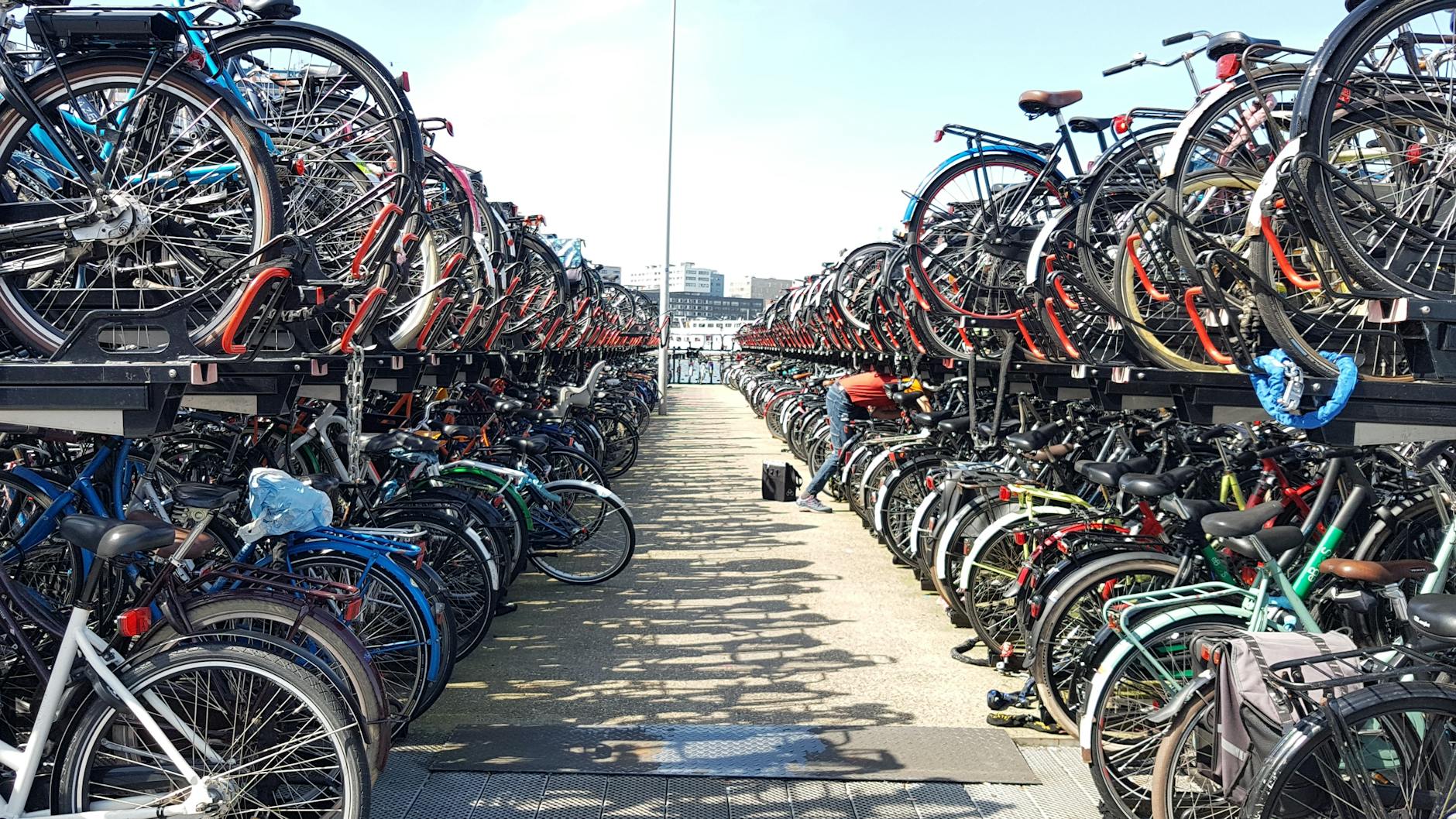
Weather is the objection that comes up first, but experienced commuters rank it below logistics. Rain, cold, and heat are manageable with appropriate clothing. Fenders eliminate road spray. A light rain jacket weighs almost nothing in a pannier. Studded tires handle ice in northern climates. What actually stops people from sustaining a bike commute is not getting rained on but rather the lack of secure bike parking, the absence of a place to change clothes, and the challenge of carrying work materials. Secure parking is a genuine problem. In the United States, bicycle theft rates in urban areas remain high, and even expensive locks can be defeated with portable angle grinders in under thirty seconds.
Commuters who lack access to indoor bike storage at their workplace face a real risk of losing a one to three thousand dollar bicycle. The most reliable solutions are employer-provided indoor parking, folding bikes that can be brought inside, or less expensive beater bikes that are functional but not attractive to thieves. Some commuters solve this by keeping a dedicated cheap bike locked at a transit station for the last mile and using a nicer bike for the longer segment stored securely at home. Cargo capacity is another practical concern. A standard rear rack and pannier setup can carry a laptop, change of clothes, and lunch with ease. Cyclists who need to transport more, such as tradespeople with tools or parents with groceries and children, face real limitations unless they invest in a cargo bike, which solves the capacity problem but introduces storage and cost challenges of its own. Understanding what you actually need to carry on a daily basis, versus what you occasionally need to carry, is the key to making the logistics work. Many commuters find that once they separate the daily carry from the weekly grocery run, the bicycle handles the former without issue.
Choosing the Right Commuter Bike Setup Without Overspending
The most common mistake new bike commuters make is buying too much bike. A four thousand dollar carbon road bike with racing geometry is a poor commuter. What works is a steel or aluminum frame with clearance for wider tires in the thirty-two to forty-two millimeter range, mounting points for fenders and racks, and a comfortable upright riding position. Flat-bar hybrid bikes and gravel bikes with swept-back handlebars both serve well in the eight hundred to fifteen hundred dollar range. For commutes under five miles on flat terrain, even a three hundred dollar single-speed is a perfectly functional daily rider.
The accessories matter more than the bike itself. Lights, both front and rear, rated for daytime visibility are non-negotiable for safety. A quality U-lock or chain lock is essential. Fenders prevent the stripe of road grime up your back that ruins work clothes. A rear rack with waterproof panniers is far more practical than a backpack, which causes back sweat and limits carrying capacity. Budget roughly two hundred to four hundred dollars for these accessories on top of the bike cost, and factor them into the purchase decision from the start rather than treating them as afterthoughts.
Where Bicycle Commuting Is Headed in the Next Five Years
The trajectory points toward continued growth, driven by three reinforcing trends. First, e-bike technology continues to improve while prices decline, making electrically assisted commuting accessible to a wider demographic. Second, cities are accelerating bike infrastructure investment as they pursue climate goals, with federal funding from programs like the Infrastructure Investment and Jobs Act directing billions toward active transportation projects through 2030. Third, remote and hybrid work patterns have shortened average commute distances for many workers, pulling more trips into the under-five-mile range where bicycles are most competitive.
The wildcard is municipal policy. Cities that adopt congestion pricing, reduce free parking, or implement low-emission zones create strong financial incentives that push commuters toward cycling even without ideological motivation. New York City’s congestion pricing zone, launched in 2025, provides a real-time test case. Early data suggests cycling across the East River bridges has increased since the toll went into effect. If congestion pricing spreads to other American cities as expected, the economic case for bike commuting will strengthen further, turning what is currently a choice into what may become the obvious default for short urban commutes.
Conclusion
The growth in bicycle commuting is not a cultural fad or a pandemic-era anomaly. It is a rational economic response to the rising cost of car ownership, worsening urban traffic, improving cycling infrastructure, and the emergence of e-bikes as a practical transportation tool. For commutes under seven miles in cities with reasonable bike infrastructure, a bicycle is now faster, cheaper, healthier, and often more reliable than a car. The savings alone, typically between three and five thousand dollars annually, represent a meaningful improvement in financial security for working households.
If you are considering making the switch, start with a single day per week on the route you would actually ride, not the route that looks good on a map. Test your parking situation, your clothing logistics, and your comfort level in traffic before committing to a bike purchase. Talk to coworkers or neighbors who already ride. Most cities have bike commuter groups that offer route advice and buddy rides for new commuters. The barrier to entry is lower than most people assume, and the compounding benefits in cost savings, health, and daily stress reduction tend to convert experimental riders into committed ones within a few months.
Frequently Asked Questions
How far is too far to bike commute?
For a conventional bicycle, most regular commuters find that anything beyond ten miles each way becomes difficult to sustain daily, primarily due to time rather than fitness. E-bikes extend this practical range to roughly fifteen to twenty miles each way, depending on terrain and battery capacity. Beyond twenty miles, the time commitment usually exceeds what most people are willing to absorb unless hybrid options like biking to a train station are available.
Do I need special clothing to bike commute?
For commutes under five miles at a moderate pace, most people can ride in their regular work clothes, especially on an e-bike where the motor reduces exertion. For longer or hillier rides, packing a change of clothes in a pannier and changing at work is standard practice. Technical cycling clothing is unnecessary for commuting and often counterproductive since it adds a changing step that discourages daily riding.
Is bike commuting safe?
The risk is real but manageable and context-dependent. Per mile traveled, cycling is more dangerous than driving but safer than motorcycling. Protected bike lanes reduce injury risk dramatically. Visible lighting, predictable riding behavior, and route selection away from high-speed traffic are the three most effective things an individual commuter can do to reduce risk. Cities with higher cycling rates tend to have lower per-cyclist crash rates, a phenomenon known as the safety-in-numbers effect.
What happens when it rains?
You get wet, or you wear a rain jacket. Fenders on the bike prevent road spray from soaking your legs and back. Waterproof panniers keep your work materials dry. Most experienced commuters find that rain is a minor inconvenience rather than a serious obstacle, and that the days they skip riding due to weather are far fewer than they expected. The exception is freezing rain and ice, which present genuine safety concerns and justify driving or transit on those specific days.
Can I bike commute if I am out of shape?
Yes, and this is one of the strongest arguments for bike commuting. Starting with a short, flat route two or three days a week builds fitness gradually without the motivation barrier of going to a gym. An e-bike makes this even more accessible by allowing the rider to choose how much effort to contribute on any given day. Many current bike commuters started from a sedentary baseline and built their fitness entirely through the commute itself.
How do I keep my bike from being stolen?
Use a high-quality U-lock or chain lock rated at the highest security level you can afford, lock through the frame and rear wheel to an immovable object, and remove or secure the front wheel if using a quick-release. Avoid leaving a bike locked outside overnight. Register your bike’s serial number with local police and the Bike Index database. If your workplace lacks indoor storage, a folding bike that comes inside with you or a less expensive dedicated commuter bike reduces the financial risk of theft.


