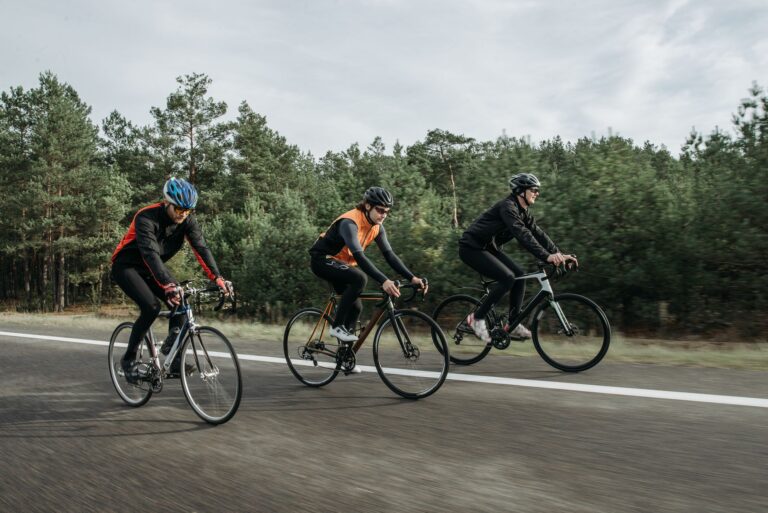
Owning a sportive road bike comes down to safe tire setup, routine drivetrain care, reliable brakes, and compatibility checks before upgrades. Here, "sportive road bike" means a road bike set up for longer event rides, where comfort and predictable handling matter alongside speed. Start with the limits of the existing frame and wheels. Wider tires, different gearing, or new wheels can improve suitability for a rider, but each change introduces fit, pressure, or component tradeoffs.
Table of Contents
- Set tire size and pressure safely
- Decide whether hookless wheels suit your needs
- Protect the drivetrain before upgrading it
- Treat poor hydraulic-brake feel as a fault
- Choose safety equipment with clear limits
Set tire size and pressure safely
Treat the frame maker's measured tire limit as a hard constraint. Trek recommends at least 4 mm of tire-to-frame clearance on its road models, checked with the tire inflated, according to its road-bike buyer's guide. The number printed on a tire is not the final measurement. Check the installed, inflated tire on the intended rim, including the tightest points around the frame.
If the measured clearance falls below the frame maker's requirement, choose a smaller tire. Pressure needs more individual tuning than tire clearance. SRAM says the starting pressure depends on the riding surface, total rider-bike-gear weight, tire width and casing, rim type, and inner rim width. Use a calculator result as a starting point, not a universal target.
- Measure clearance with the tire installed and inflated.
- Include the bike and carried gear when estimating total system weight.
- Enter the actual tire and rim details into the pressure calculator.
- Recalculate after changing tire width, casing, rims, or typical load.
Decide whether hookless wheels suit your needs
A hookless rim lacks the inward-facing bead hooks found on a traditional hooked rim. That design makes tire approval and pressure limits central compatibility questions, rather than minor setup details. For Zipp tubeless-straight-side wheels, the intended tire must be approved for the interface. Zipp also says these systems must never exceed 5 bar, or 72 psi, in its hookless tire compatibility guidance.
An unapproved tire or a required pressure above that limit rules out the combination. Installing an inner tube does not bypass those restrictions. Zipp permits a tube only with a hookless-approved tire and inflation below the rim limit. That condition also applies when a tube is carried as an emergency repair. Before buying, answer three questions:.
- Is the exact tire approved for the Zipp hookless interface?
- Can the setup operate below 5 bar or 72 psi?
- Are your intended replacement and emergency tires also compatible?
Protect the drivetrain before upgrading it
Chain care helps preserve the more expensive cassette and chainrings. Shimano recommends checking wear with a chain gauge, cleaning a dirty chain with a brush and degreaser, and applying fresh lubricant because a worn chain accelerates component wear, as explained in its maintenance guidance. Do not treat a larger or smaller cassette as an isolated swap.
Shimano says the new chain must match the shifting system's speed count and must be sized for the new sprocket arrangement. Copying the length of a worn old chain can produce the wrong result. A removed Shimano QUICK-LINK should not be reused. Shimano instructs owners to install a replacement when fitting a chain because an incorrect or worn link can detach or break.
- Measure chain wear instead of judging it by appearance.
- Clean and re-lubricate a dirty chain.
- Recalculate chain length after changing sprocket sizes.
- Match the chain to the drivetrain's speed count.
- Fit a new QUICK-LINK after removing the old one.
Treat poor hydraulic-brake feel as a fault
A hydraulic brake lever should not be dismissed as "just needing adjustment" when it feels spongy or reaches the handlebar. Shimano identifies trapped air, contamination, and fluid leaks as possible causes. Those symptoms call for a bleed or professional repair, depending on the cause.
Repeatedly changing lever position does not address contaminated fluid, air in the system, or a leak. Brake findings also change the value of an upgrade budget. Restoring dependable braking takes priority over comfort or gearing changes when the lever is spongy or reaches the bar.
Choose safety equipment with clear limits
U.S. buyers should look for a bicycle helmet carrying a certification label for 16 CFR Part 1203.
The CPSC says the standard covers peripheral vision, retention, strap strength, and impact attenuation in its bicycle helmet guidance. Certification does not make a rider invulnerable. The CPSC warns that no helmet protects against every impact, so the label is a minimum purchasing requirement rather than a guarantee against injury.