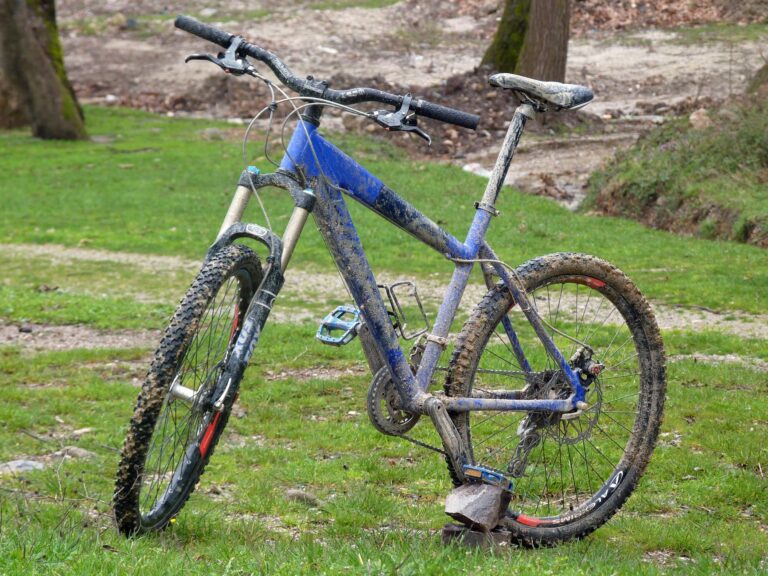
Buy a used hardtail mountain bike only after checking the frame, brakes, drivetrain, suspension fork, and component compatibility. Set a fair offer from closely matched completed sales, then subtract the cost of overdue service and replacement parts. A hardtail has front suspension but no rear suspension, so it is mechanically simpler than a full-suspension bike. That simplicity does not eliminate hidden crash damage, worn parts, or expensive compatibility mistakes.
Table of Contents
- Which damage should stop the purchase?
- How much wear is hiding in the brakes and drivetrain?
- What should move smoothly without play?
- Will the installed parts work together?
- How do you calculate a fair offer?
Which damage should stop the purchase?
inspect a clean frame in bright light. Look closely around welds, tube junctions, the head tube, bottom bracket, dropouts, and areas hidden by frame protection. Cracks, opening seams, severe dents, or obvious misalignment justify walking away or arranging a professional inspection. Scratches usually affect appearance, but impact marks require more caution.
Ask where and how the damage occurred, then compare the answer with the location and shape of the mark. A vague crash history is a risk factor, not proof that the bike is sound. Treat suspected carbon impact damage as a stop sign. Trek's Bicycle Owner's Manual warns that carbon damage may be invisible and may cause sudden breakage; the affected part should remain unused until replaced or inspected by a shop.
How much wear is hiding in the brakes and drivetrain?
Remove or illuminate the brake pads so you can assess the friction material rather than judging by lever feel alone. Shimano's bike-care guidance says pads near 0.5 mm, or worn unevenly toward the metal backing, need replacement. Also check for scored rotors, rubbing, leaks, and levers that pull unusually close to the handlebar. Use a chain-wear gauge if possible.
Inspect the cassette and chainring teeth, then shift through every gear during the test ride. Skipping under pedal pressure, repeated chain loss, or noisy operation may indicate more than a minor cable adjustment. Budget for the drivetrain as a system. A new chain may not run correctly on heavily worn gears, while replacing a cassette can expose wear at the chainring. Price the likely group of parts and labor before negotiating.
What should move smoothly without play?
Compress the suspension fork repeatedly and use its available adjustments. Watch for damaged stanchions, persistent oil leakage, sticking, knocking, or poor rebound control. If the seller cannot document service, treat the next service as an immediate cost rather than assuming it was completed. Lift each wheel and spin it.
Check for side-to-side rim movement, loose spokes, rough hub bearings, tire cuts, and rim damage. Then hold the front brake and rock the bike to detect headset play. Turn the cranks and pedals by hand, and push each crank sideways. Grinding, binding, or movement can point to bearing or pedal problems. During the ride, listen for noises while seated, standing, braking, and steering; changing your position helps isolate their source.
Will the installed parts work together?
Write down the exact frame model, model year, wheel size, axle standards, drivetrain speed, cassette range, brake mounting details, and fork specifications. Do not rely on descriptions such as "boost," "12-speed," or "recently upgraded" without part numbers. Mixed aftermarket drivetrains deserve careful verification.
SRAM says its systems are designed and tested as combinations of derailleur, chain, cassette, and chainring; its compatibility explanation gives an 11-speed chainring paired with a 12-speed chain as an example that can cause problems. Confirm that replacement parts remain available in the required standards. If you plan a major upgrade, check the frame's exact model and year against the component maker's compatibility information before assigning value to that possibility.
How do you calculate a fair offer?
Start with completed sales for the same model, year, frame size, and broadly similar condition. eBay's Product Research description says its data include actual sold prices, price ranges, shipping, condition filters, and up to three years of sales history. Asking prices only reveal what sellers hope to receive.
Separate the bike's value from the seller's spending. Upgrades add value only when they are compatible, useful to you, and in good condition. Accessories you would remove should contribute little or nothing to your offer. Build the offer from comparable sales, then subtract realistic near-term costs: Before paying, photograph and search the frame serial number, confirm that the seller's identity and ownership story make sense, and search the exact make and model for safety recalls.
- Brake pads, rotors, tires, or damaged wheels
- Chain, cassette, chainring, cables, or derailleur work
- Fork service without credible records
- Bearing, headset, pedal, or control replacement
- Professional evaluation of questionable damage