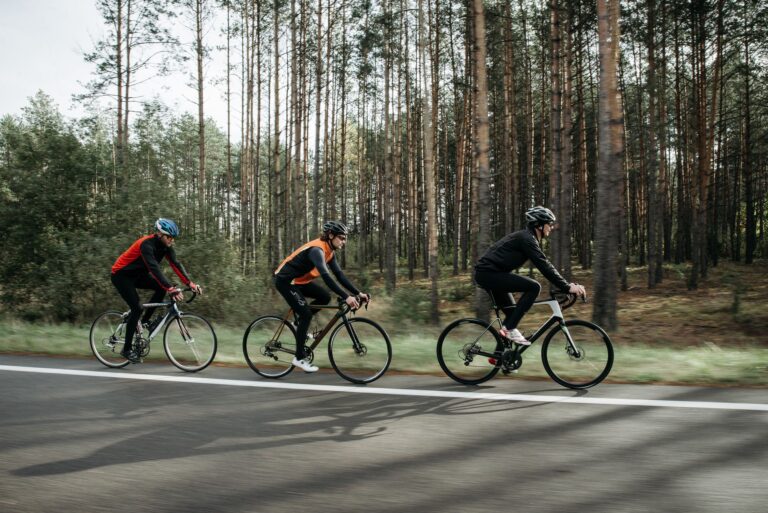
For most beginners, riding every day is good for your joints — cycling is a low-impact, non-weight-bearing motion that moves the knee and hip through a smooth arc without the repeated pounding of running. The risk is not the daily frequency itself; it is doing too much too soon on a badly fitted bike, which is how beginners end up with aching knees. So the honest answer has two halves. Daily cycling is joint-friendly in kind, but your tendons, kneecaps and lower back still need time to adapt to a new movement, and a saddle two centimetres too low can turn a pleasant habit into a nagging ache within a fortnight.
Table of Contents
- Why cycling is gentler on joints than most exercise
- What actually hurts beginners, and why it isn't the joint wearing out
- Set the bike up before you add the miles
- How to structure daily riding so it builds you up
- When to back off or get it looked at
- Cycling's one real gap — and what to add
- Frequently Asked Questions
Why cycling is gentler on joints than most exercise
When you walk or run, each footstrike sends an impact force up through the ankle, knee and hip. Cycling removes that entirely: the saddle carries your body weight, and your legs push against pedals rather than the ground. The joint moves through a repeated, guided path with no jarring at either end. That is why cycling and stationary cycling are so commonly recommended as exercise for people with knee osteoarthritis — the mode of exercise keeps the joint moving and strengthens the muscles around it without the impact loading.
Movement also matters mechanically: cartilage has no blood supply and depends on joint motion to move fluid and nutrients through it. A joint that gets used regularly is generally better fed than one that sits still. The qualifier is that cycling's gentleness is about *impact*, not about effort. A hard pedal stroke in a heavy gear still loads the knee considerably, particularly across the kneecap. Low-impact does not mean low-force.
What actually hurts beginners, and why it isn't the joint wearing out
The most common beginner complaint is pain at the front of the knee, around or under the kneecap. It is usually a load-tolerance problem in the tendon and the kneecap's contact surface, not damage to the joint.
The tissue has simply been asked to do more work than it is currently conditioned for. Three ingredients produce it almost every time: Pain at the back of the knee or an over-stretched, rocking pedalling motion points the other way — a saddle too high. Hip or lower-back ache is frequently a reach problem: bars too far away or too low for a beginner's current flexibility, so the pelvis rotates and the back compensates.
- **Volume jumping.** Going from no riding to an hour a day in week one.
- **Low cadence, high gear.** Grinding at 50-60 pedal revolutions per minute pushes hard through each stroke; spinning at 80-90 in an easier gear does the same work with less force per revolution.
- **Saddle too low or too far forward.** This keeps the knee bent deeper through the stroke and raises pressure behind the kneecap.
Set the bike up before you add the miles
Fit is the highest-value thing a beginner can fix, and it costs nothing to check. The rough rule: with the pedal at the bottom of the stroke and your heel on it, your leg should be nearly straight; when you move to the ball of the foot, a slight bend remains.
A common starting point is around 25-35 degrees of knee bend at the bottom of the stroke, but you are aiming for a comfortable, non-rocking pedal action rather than a number. If knee pain persists after a sensible fit check, a professional bike fit is usually cheaper than physiotherapy and solves more beginner knee pain than any amount of stretching.
- Adjust saddle height in small increments — 5mm at a time, then ride a few days before judging.
- Check that your hips stay level and do not rock side to side.
- Set cleats (if you ride clipless pedals) so your foot sits in its natural rotation, not twisted. Fixing your foot in the wrong angle transmits that twist straight to the knee.
- Keep knees tracking over the feet, not swinging in or out.
How to structure daily riding so it builds you up
Daily riding works when the days are not all the same. The tissue adapts during recovery, so the useful pattern is easy riding most days with a couple of harder efforts, rather than a moderate grind every day.
A workable first month for someone new to it: Hills and headwinds are the hidden intensity. If your route forces long, heavy-gear climbing, shift earlier than feels natural, or pick flatter routes while you build up. Gearing that lets you spin up a climb is worth more to your knees than fitness you do not have yet.
- Weeks 1-2: 20-30 minutes most days, flat, easy gears, conversational effort.
- Weeks 3-4: extend one or two rides to 45-60 minutes; keep the rest short.
- Keep increases modest week to week, and repeat a week rather than jump if anything aches.
- Treat one day as genuinely easy or off the bike — short and gentle counts.
When to back off or get it looked at
Mild muscle soreness that eases as you warm up is normal adaptation. Joint pain behaves differently, and a few patterns are worth taking seriously: For any of these, stop adding load and see a doctor or physiotherapist, particularly if you have an existing joint diagnosis or a past knee injury or surgery. Anyone with established arthritis or a recent operation should get a clinician's view on how much daily riding is appropriate for their specific joint before building a habit around it.
- Pain that gets worse during a ride rather than better.
- Knee pain that persists for hours afterwards, or wakes you at night.
- Swelling, warmth, clicking with pain, or a joint that catches or gives way.
- Pain that appears suddenly mid-ride rather than building gradually.
- Numbness or tingling in the hands, feet or groin — a pressure and fit issue, not a joint one, but it should not be ridden through.
Cycling's one real gap — and what to add
Because cycling is non-weight-bearing, it does little for bone density. Bone responds to impact and loading, and seated pedalling supplies neither. Road cyclists who train heavily and do nothing else are a recognised group of interest in bone-health research for exactly this reason.
This is not an argument against riding every day; it is an argument for adding something alongside it. Two or three short sessions a week of walking, bodyweight squats, lunges, step-ups or basic resistance training cover the gap, and the hip and glute strength they build also stabilises the knee on the bike. Beginners who add simple strength work tend to tolerate rising mileage better than those who only ride. If you ride daily and do nothing else, the single most useful addition is a weekly session of loaded, upright leg work — not more cycling.
Frequently Asked Questions
Is a stationary bike easier on the joints than a road bike?
The pedalling motion is the same, so the joint loading is comparable. A stationary bike removes road vibration and lets you control resistance precisely, which makes it easier to stay in light gears while you build up.
Does cycling wear out knee cartilage over time?
There is no good evidence that recreational cycling damages healthy knee cartilage. It is routinely recommended for people who already have knee osteoarthritis, which is the opposite of what you would expect from a joint-destroying activity.
Should I stretch before riding?
A few minutes of easy pedalling in a light gear is a better warm-up than static stretching. If tight hips or hamstrings limit how you sit on the bike, address that in a separate mobility session rather than immediately before a ride.
How many rest days does a beginner need?
If rides are genuinely easy and short, daily riding is fine from the start. The rest requirement scales with intensity and duration — once you add long or hard rides, build in easier days around them.