The best cycling stretching routine splits into two distinct phases: dynamic stretches for five to seven minutes before you ride, and static stretches for ten to fifteen minutes after you get off the bike. This is not a matter of preference or coaching philosophy. Research published in PubMed has shown that static stretching immediately before moderate-intensity cycling reduces cycling economy and time-to-exhaustion, while post-ride static stretching restores muscles to their resting length and promotes recovery. If you have been touching your toes in the parking lot before a Saturday group ride, you have likely been undermining the effort you are about to put in.
The reason this matters goes beyond marginal performance gains. Knee pain affects 40 to 60 percent of recreational cyclists, and 58 percent of all cyclists reported lower back pain in the previous 12 months according to a study published in PMC. Most of these overuse injuries trace back to tight muscles or limited range of motion in the quadriceps, hamstrings, glutes, and hip flexors, all of which shorten and tighten through the repetitive contraction cycle of pedaling. A proper stretching routine, performed at the right time, directly addresses these problems. This article covers exactly which dynamic stretches to perform before riding, the key static stretches for after, the five muscle groups that matter most, and the scientific evidence behind why timing makes all the difference.
Table of Contents
- Why Does the Timing of Your Cycling Stretching Routine Matter So Much?
- The Five Muscle Groups Every Cyclist Needs to Target
- A Pre-Ride Dynamic Stretching Routine That Actually Works
- A Post-Ride Static Stretching Routine for Recovery
- Common Mistakes That Undermine Your Stretching Results
- What the Long-Term Research Says About Stretching and Performance
- Building a Sustainable Stretching Habit
- Conclusion
- Frequently Asked Questions
Why Does the Timing of Your Cycling Stretching Routine Matter So Much?
The distinction between pre-ride and post-ride stretching is not just a suggestion from coaches who like tidy routines. A 2011 study by Esposito et al., published in PubMed, demonstrated that static stretching performed immediately before cycling at moderate intensity measurably reduced performance. The American College of Sports Medicine has gone further, recommending that static stretching not be included as part of any warm-up routine before strength- and power-related activities. The mechanism is straightforward: holding a muscle in a lengthened position for an extended period temporarily reduces its ability to generate force. When you are about to ask your legs to push watts for the next two hours, that is exactly what you do not want. Dynamic stretching, by contrast, primes the muscles without compromising their contractile capacity. Movements like leg swings, hip circles, and windmill rotations increase blood flow to the working muscles, raise tissue temperature, and activate the neuromuscular pathways you are about to rely on.
Five to seven minutes of dynamic stretching before a ride is the current best-practice recommendation. Think of it as the difference between cold-starting an engine and letting it idle for a moment. A rider who warms up with leg swings and walking lunges will feel noticeably more fluid in the first ten minutes of a ride compared to someone who either skipped warming up or spent five minutes holding a quad stretch against their car. There is one important nuance worth noting. Research has found no detrimental effect on strength when static stretches are held for 30 to 45 seconds, but performance losses increase sharply after 60 seconds of sustained static stretching. So if you absolutely prefer a brief static stretch before riding because of a specific tight spot, keeping it under 45 seconds per hold is unlikely to cost you much. But as a general rule, save the deep holds for after the ride.

The Five Muscle Groups Every Cyclist Needs to Target
Cycling is a repetitive, single-plane motion that loads the same muscles thousands of times per ride. Five muscle groups consistently appear in research and coaching literature as the most critical areas for cyclists to stretch. The hip flexors and psoas sit at the top of the list because the forward-leaning cycling position keeps them in a shortened state for the entire ride. Chris Carmichael, founder of CTS and longtime coach of Lance Armstrong, has specifically identified tight hip flexors from the riding position as a primary cause of lower back pain off the bike. If you ride three or more days per week and sit at a desk the rest of the time, your hip flexors are almost certainly tighter than they should be. The quadriceps and hamstrings are next. The quads do the heavy lifting on every pedal stroke and tightness here contributes directly to knee pain, the single most common cycling injury.
Hamstrings work in a shortened range during cycling and when they tighten, they affect pedal stroke efficiency and pull on the pelvis in ways that compound lower back problems. The IT band and glutes round out the lower body targets. IT band tightness leads to lateral knee pain, a condition familiar to enough cyclists that IT band syndrome has its own abbreviation in sports medicine circles. Finally, the lower back and chest and shoulders bear the sustained load of holding your body in a forward riding position, sometimes for hours at a stretch. However, if you are a casual rider doing 30-minute commutes on an upright city bike, your stretching priorities will look different from those of a road cyclist spending three hours in an aggressive drop-bar position. The chest and shoulder component, for instance, matters far less when you are sitting nearly upright. Tailor the routine to how you actually ride, not to a generic list.
A Pre-Ride Dynamic Stretching Routine That Actually Works
A practical pre-ride dynamic routine does not require a yoga mat or a dedicated space. You can do it standing next to your bike. Start with leg swings, holding onto your bike or a wall for balance. Swing one leg forward and back in a controlled arc for 15 to 20 repetitions per side. This targets the hip flexors and hamstrings simultaneously without holding either in a stretched position. Next, move to hip circles: stand on one leg and draw large circles with the opposite knee, ten in each direction. This mobilizes the hip joint and activates the glutes that stabilize your pelvis on the saddle.
Walking lunges with a torso rotation cover the quads, hip flexors, and thoracic spine in a single movement. Take ten steps forward, and at the bottom of each lunge, rotate your upper body toward the forward knee. Follow these with windmill rotations, standing with feet wide and alternating touching each hand to the opposite foot, which wakes up the posterior chain and opens the chest. Finish with 30 seconds of high knees or light jogging in place to bring your heart rate up slightly. The entire sequence takes five to seven minutes. A rider who tested this against their old routine of static quad and hamstring stretches would likely notice two things: the legs feel more responsive in the opening miles, and the sense of stiffness that usually lingers for the first 15 minutes of a ride is largely gone. That initial sluggishness many cyclists accept as normal is often just the cost of skipping a proper dynamic warm-up.
A Post-Ride Static Stretching Routine for Recovery
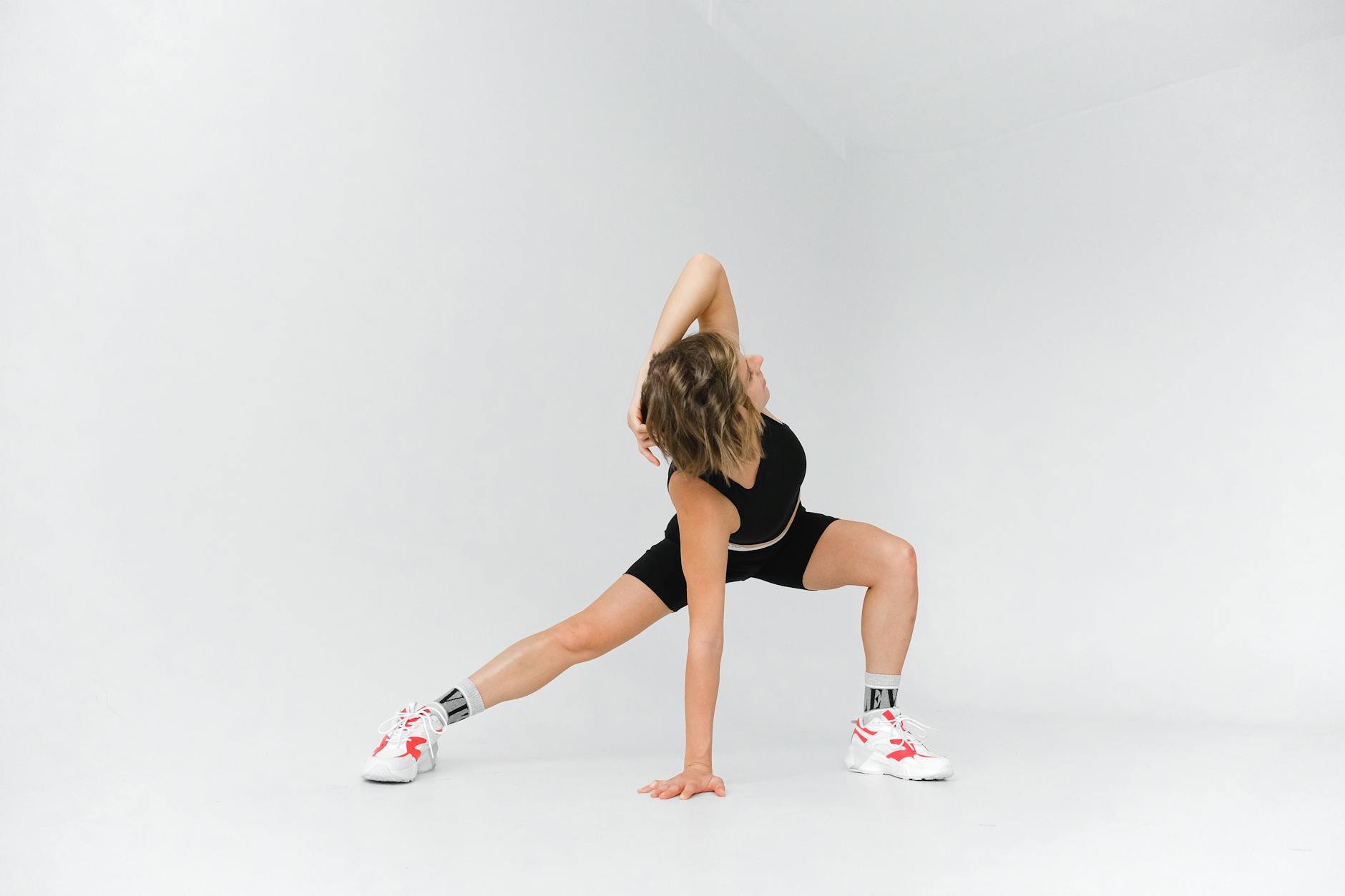
Post-ride is where static stretching earns its place. The goal is to restore muscles to their resting length after they have spent the ride in repeated contraction. The recommendation from multiple sources, including Ergon Bike and Cycling Weekly, is 10 to 15 minutes of static stretching, holding each stretch for 30 to 45 seconds and repeating for three to five sets per muscle group. For those willing to invest more time, holds of two to three minutes provide even deeper benefit by working into the connective tissue rather than just the muscle belly. Chris Carmichael’s five-stretch post-ride routine provides a solid framework. First, a kneeling hip flexor stretch, with the rear knee on the ground and the front foot forward, sinking the hips down and slightly forward to open the psoas. Second, a doorway chest stretch to reverse the forward-shoulder position from riding.
Third, a seated or standing hamstring stretch, hinging at the hips rather than rounding the back. Fourth, a standing quad stretch, pulling the heel toward the glute while keeping the knees together. Fifth, a spinal decompression stretch such as a child’s pose or a standing forward fold, letting the lower back decompress after hours of supporting your upper body weight. The tradeoff here is time versus consistency. A 15-minute routine with five sets per stretch is ideal, but a five-minute routine hitting each area once is vastly better than no stretching at all. If you find yourself skipping the full routine because it feels like too much, cut it to one or two sets per stretch and add a foam rolling session later in the evening. Consistency matters more than duration, and the rider who stretches for five minutes after every ride will see better results over a season than the one who does a 20-minute session once a week.
Common Mistakes That Undermine Your Stretching Results
The most pervasive mistake is the one this article opened with: performing static stretches before a ride. But even riders who get the timing right often make errors that limit the benefits. Bouncing during static stretches, a habit left over from decades of outdated gym class instruction, triggers the stretch reflex and causes the muscle to tighten rather than lengthen. Every static stretch should be a slow, steady hold with controlled breathing. Another common problem is stretching cold muscles that have not been warmed up at all. If you ride in the morning and your post-ride stretch happens in a cold garage, the muscles cool down quickly and become less pliable.
Ideally, begin your stretching within five minutes of finishing the ride while tissue temperature is still elevated. If circumstances force a delay, a few minutes of light movement like walking or bodyweight squats can bring the temperature back up enough to stretch safely. A subtler issue is neglecting the upper body entirely. Cyclists often focus on the legs because that is where they feel the effort. But 41 percent of cyclists who experienced lower back pain sought medical attention for it, according to research published in PMC, and much of that pain connects to the chest, shoulders, and thoracic spine being locked in a forward-flexed position. Among professional cyclists, 22 percent of time-loss injuries occurred in the lower back, making it the second most common problem area after the knee at 57 percent. Skipping upper body stretches after a long ride is a decision that compounds over months and years.

What the Long-Term Research Says About Stretching and Performance
A 2023 meta-analysis by Thomas et al. published in the Journal of Strength and Conditioning Research reviewed 35 studies encompassing 1,179 subjects and found that regular static stretching programs, averaging eight weeks at three to four days per week with approximately four sets of one minute per stretch, produced a significant small effect on improving dynamic strength. That finding is meaningful because it contradicts the old assumption that stretching only improves flexibility and has no bearing on force production.
For cyclists specifically, the performance connection is indirect but real. Improved hip and lower back flexibility allows a rider to hold a more powerful or aerodynamic position on the bike without compensating elsewhere in the kinetic chain. A rider who cannot comfortably flatten their back on the drops will either avoid that position entirely, losing aerodynamic advantage, or force themselves into it and develop lower back pain within an hour. Flexibility is not the most glamorous component of cycling fitness, but it is the one that quietly determines how long you can sustain the positions where real speed is made.
Building a Sustainable Stretching Habit
The biggest barrier to a consistent stretching routine is not knowledge but execution. Most cyclists know they should stretch. The problem is that after a hard ride, the couch is more appealing than a hip flexor stretch. One approach that works for many riders is attaching the stretching routine to an existing habit. If you always clean your bike after a ride, stretch first while the muscles are still warm. If you log your ride on an app, do it while holding a hamstring stretch. The routine does not need to feel like a separate workout.
It just needs to happen. Looking forward, the trend in cycling coaching is moving toward integrated mobility work rather than isolated stretching sessions. This means combining stretching with foam rolling, strength training, and movement drills that address the same muscle groups from different angles. The science supports this approach. Static stretching alone helps, but pairing it with targeted strengthening of the glutes and core produces more durable results. For the recreational cyclist who rides three to five times per week, the minimum effective dose is five to seven minutes of dynamic movement before each ride and ten minutes of static stretching after, targeting the hip flexors, quads, hamstrings, glutes, and upper back. That investment of roughly 15 minutes per ride day is among the simplest ways to stay injury-free and ride longer into the season and into the years ahead.
Conclusion
The evidence is clear on what works. Dynamic stretching before rides for five to seven minutes to prime the muscles without sacrificing power output. Static stretching after rides for ten to fifteen minutes, holding each position for 30 to 45 seconds across three to five sets, focusing on the hip flexors, quadriceps, hamstrings, glutes and IT band, and lower back and shoulders. Getting this order wrong, specifically performing static stretches before riding, actively harms performance, a fact supported by research from PubMed and guidance from the American College of Sports Medicine. Start with the basics.
If you currently do no stretching at all, begin with just the post-ride routine. Pick three stretches, one each for the hip flexors, quads, and hamstrings, and hold each for 30 seconds after your next ride. Build from there. The riders who stay in the sport for decades without chronic knee or back pain are rarely the ones with the best bikes or the highest VO2 max. They are the ones who take care of the small things consistently. Stretching is one of the smallest and most effective of those things.
Frequently Asked Questions
Should I stretch before or after cycling?
Both, but with different types of stretching. Use dynamic stretches like leg swings and hip circles for five to seven minutes before riding. Save static stretches with sustained holds for after the ride. Static stretching before cycling has been shown to reduce cycling economy and time-to-exhaustion.
How long should I hold each stretch after a ride?
Hold each static stretch for 30 to 45 seconds and repeat for three to five sets per muscle group. Research indicates that holds under 30 seconds provide minimal benefit, while holds of two to three minutes can work deeper into the connective tissue for greater recovery benefit.
Can stretching prevent knee pain from cycling?
Stretching alone is not a guaranteed fix, but tightness in the quadriceps, hamstrings, and IT band is directly linked to knee pain, which affects 40 to 60 percent of recreational cyclists. A consistent post-ride stretching routine targeting these areas reduces one of the primary risk factors.
Does stretching actually improve cycling performance?
Indirectly, yes. A 2023 meta-analysis of 35 studies found that regular stretching programs improved dynamic strength. For cyclists, better hip and lower back flexibility allows a more aerodynamic riding position and a more efficient pedal stroke, both of which translate to measurable gains on the road.
What if I only have five minutes to stretch after a ride?
Focus on three stretches: a kneeling hip flexor stretch, a standing quad stretch, and a forward fold for the hamstrings and lower back. One set of 45 seconds each will not match a full routine, but it is significantly better than skipping stretching entirely. Consistency at a reduced volume beats an occasional comprehensive session.
Is foam rolling a substitute for stretching?
Foam rolling and stretching address different aspects of muscle recovery. Foam rolling breaks up fascial adhesions and increases blood flow, while stretching lengthens the muscle fibers themselves. The best approach is to use both, foam rolling first to release tension and then stretching to improve range of motion. However, if you must choose one, post-ride static stretching has stronger evidence for injury prevention in cyclists.