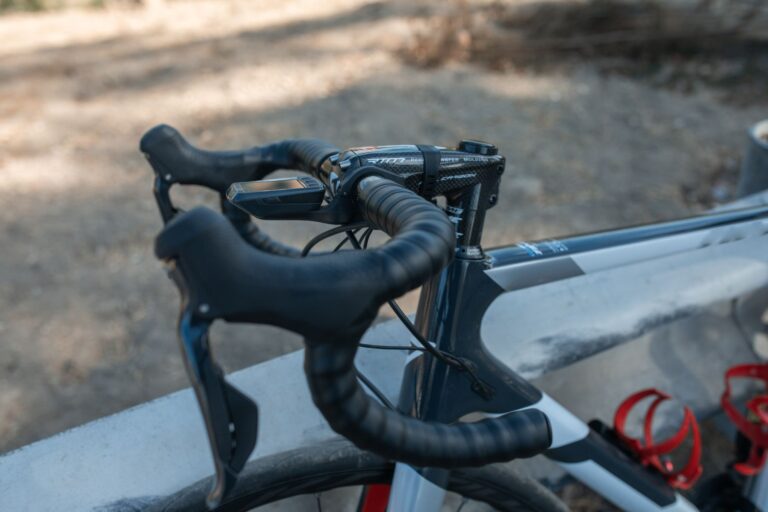
Carbon bicycle frames can be recycled today, but only by destroying what makes them frames. Two industrial processes do the work — pyrolysis, which burns the plastic resin off the fibre in a low-oxygen furnace, and solvolysis, which dissolves that resin in hot pressurised fluid — and both return loose fibre that goes into moulded parts, not into another frame. That gap between "recyclable" and "recycled into a bike" is the whole story for owners. Repairing a cracked frame keeps far more value and cuts far more emissions than sending it to a furnace, so recycling belongs at the end of the decision, not the start.
Table of Contents
- What pyrolysis and solvolysis actually do to the fibre
- Why recycled fibre never becomes another frame
- Where a rider can actually send a dead frame
- Repair first — the numbers are not close
- What to make of "recycled carbon" claims on products
- Frequently Asked Questions
What pyrolysis and solvolysis actually do to the fibre
A carbon frame is carbon-fibre-reinforced polymer (CFRP): stiff fibres locked in a cured epoxy matrix that cannot be melted back apart. Recycling therefore means removing the epoxy and keeping the fibre. Pyrolysis heats the laminate in a near-oxygen-free furnace until the resin breaks down into gas and char. Solvolysis instead attacks the resin chemically, using solvents held above their critical point so they behave as aggressive, penetrating fluids.
Pyrolysis is the dominant commercial route, and its output quality depends heavily on how tightly the furnace is controlled. According to a 2025 review in the MDPI *Journal of Composites Science*, optimised pyrolysis holds tensile strength loss to roughly 10% of virgin fibre, while energy-autonomous plants — those running on their own process gases — return fibre at about 80% of virgin strength. Solvolysis is not property-neutral either. Research published by Taylor & Francis in *Composites Part C / Advanced Composites* found water/ethanol solvolysis recovered fibres with tensile strength down 18–36% and elastic modulus down 7.2–20.2%, the spread depending on solvent ratio, temperature and reaction time. Vogiantzi, Tserpes and colleagues, writing in the *Journal of Composite Materials*, reported that supercritical-water solvolysis of 3D woven CFRP at 390 °C and 265 bar for 60 minutes stripped the resin effectively while keeping mechanical properties acceptable.
Why recycled fibre never becomes another frame
The energy case for recycling is overwhelming. The same MDPI review put supercritical n-butanol solvolysis at 49.21 MJ/kg and steam thermolysis at 71.64 MJ/kg, against roughly 286 MJ/kg to make virgin carbon fibre. Recovering fibre costs a fraction of making it. The structural case is not. A frame's strength comes from continuous fibres laid in specific directions — a tube resists pedalling loads because its fibres were oriented to do exactly that.
Conventional recycling cuts and shreds laminate into short, randomly oriented fibre, and as road.cc's feature on recycled carbon in bikes explains, the resulting low fibre-volume-fraction material cannot be made back into a frame, wheelset or handlebar. It ends up in injection-moulded and non-structural parts. One line of research aims directly at that bottleneck. An Elsevier *Procedia* case study on end-of-life bicycle components recovered intact carbon fabric architecture from frames and wheels, skipping the shredding step that normally destroys fibre alignment. Preserved fabric is worth far more than chopped fibre, because the orientation that gives a laminate its stiffness survives the process.
Where a rider can actually send a dead frame
Manufacturer take-back exists, and it is free, but it is weighted toward factory waste rather than customer bikes. Trek ships 3,500–4,500 lb of carbon scrap per month to Materials Innovation Technologies, according to CompositesWorld's report on the programme — warranty frames and test-broken frames, but also uncured trimmings and out-of-spec mouldings, totalling over 70,000 lb (31,750 kg) in the first year. The rider-facing route is Specialized's. Bicycle Retailer and Industry News reported that Specialized collects damaged carbon frames of any brand through bike shops at no cost to the owner and forwards them to the same processor.
Brand does not matter; a shop drop-off is the whole process. Understand what you are agreeing to. The frame is gone, nothing comes back to you, and the fibre is down-cycled into other products. That is a reasonable outcome for a frame that cannot be saved, and a poor one for a frame that can.
Repair first — the numbers are not close
Ruckus Composites, a dedicated carbon repair shop, has inspected more than 16,000 bicycles and repairs around 1,000 frames a year using aerospace taper-scarf repair, in which the damaged laminate is ground back at a shallow angle and rebuilt ply by ply. Damage is mapped first with ultrasound, infrared and dye non-destructive inspection. The shop's own carbon footprint analysis measured repair at up to 95% fewer greenhouse-gas-equivalent emissions than replacing the frame.
That figure reframes the whole question. Recycling saves energy against making new fibre; repair avoids needing new fibre at all, and keeps the frame's engineered layup intact. Per Ruckus's repair process documentation, a structurally repairable crack is the highest-value outcome available, and recycling should only be the path once damage extent rules repair out. A practical order of operations after a crash:.
- Stop riding the frame. A cracked laminate can fail suddenly under load.
- Get a professional inspection before deciding anything — visible damage and actual damage are different maps, which is why shops use ultrasound and infrared.
- Ask for a repair quote and compare it against replacement cost, not against zero.
- Treat a free take-back offer as the fallback, not the default.
- If repair is ruled out, use a shop drop-off route rather than landfill.
What to make of "recycled carbon" claims on products
Because recovered fibre is short and randomly oriented, a product advertising recycled carbon content is almost certainly a moulded or non-structural component rather than a load-bearing one. That is a legitimate use of the material, not a marketing trick — but it does not mean the industry has closed the loop on frames.
The honest summary of the current state: the chemistry works, the energy savings are real and large, the collection routes exist and cost the rider nothing, and the output cannot yet rebuild the thing it came from. Preserved-architecture recovery, as demonstrated on bicycle components in the *Procedia* study, is the part of the field that would change that.
Frequently Asked Questions
Can a cracked carbon frame be recycled at my local bike shop?
Specialized accepts damaged carbon frames of any brand through bike shops at no cost, forwarding them to Materials Innovation Technologies for processing.
Does recycled carbon fibre lose strength?
Yes. Optimised pyrolysis holds the loss near 10%, energy-autonomous pyrolysis returns about 80% of virgin strength, and water/ethanol solvolysis has shown 18–36% strength loss.
Why can't recovered fibre be used for a new frame?
Shredding leaves short, randomly oriented fibres, producing low fibre-volume-fraction composites suited to injection-moulded and non-structural parts rather than frames, wheels or bars.
You Might Also Like
- E-bike battery recycling pathways, transport rules, and second-life uses: Current Technologies, Evidence, and Practical Limits
- Bicycle repairability scores based on bearings, batteries, firmware, and spare parts: Current Technologies, Evidence, and Practical Limits
- E-bike battery recycling pathways, transport rules, and second-life uses: What Manufacturers, Shops, and Cyclists Should Compare