Understanding bike cleaning products that professionals recommend is essential for anyone interested in bicycles and cycling. This comprehensive guide covers everything you need to know, from basic concepts to advanced strategies. By the end of this article, you’ll have the knowledge to make informed decisions and take effective action.
Table of Contents
- What Bike Cleaning Products Do Professional Mechanics Actually Use Daily?
- Why Bike-Specific Degreasers Outperform Household Alternatives
- How Riding Conditions Should Change Your Cleaning Product Choices
- Building a Professional-Level Home Cleaning Kit on a Realistic Budget
- Common Cleaning Mistakes That Damage Bikes and Void Warranties
- The Professional Approach to Carbon Fiber and Electronic Component Cleaning
- What the Next Generation of Bike Cleaning Products Looks Like
What Bike Cleaning Products Do Professional Mechanics Actually Use Daily?
Walk into any high-volume bike shop and you will find a surprisingly small rotation of cleaning products. The workbench staples tend to be a citrus-based degreaser for drivetrains, a mild soap solution for frames and wheels, isopropyl alcohol for disc brake rotors, and a quality chain lube. Muc-Off and Finish Line dominate the American and European shop market not because they are the only options but because their formulations have proven reliable across thousands of bikes without damaging seals, anodized parts, or carbon fiber. Pedro’s products hold a loyal following among mechanics who prefer plant-based solvents, and their Pig Juice degreaser is considered one of the most effective options available for heavy drivetrain contamination. The distinction between a professional product and a consumer product often comes down to concentration and rinsing behavior. Professional-grade degreasers like Park Tool CB-4 Bio ChainBrite are formulated to emulsify grease quickly and rinse clean without leaving residue that attracts new dirt.
Cheaper alternatives sometimes leave a film that actually accelerates chain wear. A telling comparison: a shop in Boulder, Colorado, tracked chain replacement intervals across two years and found that bikes maintained with proper bike-specific degreasers averaged 20 to 30 percent longer chain life compared to those cleaned with generic automotive degreasers. The difference was not in how clean the chain looked immediately after washing but in how quickly it attracted new grit afterward. Professional mechanics also invest in tools that most home mechanics overlook. A chain cleaning device like the Park Tool CM-5.3 Cyclone paired with a proper degreaser does a measurably better job than soaking alone. Stiff-bristled brushes for cassettes, soft brushes for frames, and dedicated sponges that never touch the drivetrain are standard in any well-organized shop. The product matters, but the application method matters just as much.
Why Bike-Specific Degreasers Outperform Household Alternatives
The temptation to use household degreasers, automotive brake cleaner, or even gasoline on a bike drivetrain is understandable — they cut grease fast and they are cheap. However, these products create problems that show up weeks or months later. Automotive degreasers are formulated for metal-on-metal applications and do not account for the rubber seals in bike hubs, bottom brackets, and pedals. A single careless application of a petroleum-based solvent can compromise the seals on a set of ceramic bearings that cost hundreds of dollars. Bike-specific degreasers from reputable manufacturers are formulated to be aggressive on chain lube and road grime while remaining safe for the rubber, plastic, and composite materials found throughout a modern bicycle. The biodegradable formulations that have taken over the professional market in the last decade deserve particular attention.
Products like Muc-Off Bio Degreaser and Finish Line EcoTech use plant-derived solvents that break down grease effectively without the toxicity or environmental concerns of traditional solvents. However, if you are dealing with heavily neglected drivetrains — the kind caked with months of accumulated grime mixed with road salt — these biodegradable options sometimes require a second application or longer soak time compared to harsher chemical degreasers. Most professionals accept this tradeoff gladly, but it is worth knowing that the gentler formulations are not always one-pass solutions on severely contaminated components. One category that professionals specifically warn against is the all-purpose “miracle” spray that claims to clean, lubricate, and protect in one step. These products invariably compromise on all three functions. The cleaning agents in them are too weak for serious degreasing, and the lubricant components are too light to provide meaningful chain protection. Separate products for separate jobs remains the professional consensus, even if it means a few more bottles on the shelf.
How Riding Conditions Should Change Your Cleaning Product Choices
A road cyclist in Arizona and a mountain biker in the Pacific Northwest face fundamentally different cleaning challenges, and their product choices should reflect that. Dry, dusty conditions call for a lighter degreaser and more frequent but less intensive cleaning sessions. Wet, muddy conditions demand heavier-duty degreasing and a frame protectant that repels water. Professional race mechanics adjust their entire cleaning protocol based on the stage or race conditions — a cyclocross mechanic at a muddy Belgian race will go through a liter of degreaser in a single day, while a road team mechanic at a dry Spanish grand tour might use a fraction of that over a week. For riders in wet climates, adding a frame protection spray like Muc-Off Bike Protect or GT85 after washing creates a thin barrier that makes the next wash easier and provides mild corrosion resistance to steel and aluminum components.
Professionals in the UK and northern Europe consider this step non-negotiable. For riders in dry, dusty environments, the priority shifts to using a dry chain lube like Squirt or Finish Line Dry and cleaning more frequently with a lighter touch — a damp rag and a quick brush of the cassette rather than a full degreasing session. Salt exposure, whether from coastal riding or winter road salt, introduces an entirely different level of urgency. Salt-contaminated grime is actively corrosive, and professionals recommend a thorough rinse with clean water as soon as possible after exposure, followed by a complete cleaning session within 24 hours. No cleaning product fully compensates for leaving salt on a bike for days. A cyclocross team mechanic based in new England shared that their single most effective cleaning “product” during the salt season is simply a bucket of warm water applied immediately after every ride, before any chemical cleaners even come out.

Building a Professional-Level Home Cleaning Kit on a Realistic Budget
The gap between a professional shop setup and a home cleaning station is smaller than most people assume. A complete, professional-quality home kit can be assembled for roughly 60 to 80 dollars, and most of those products last months of regular use. The essentials break down into five categories: degreaser, bike wash or soap, chain lubricant, brushes, and protective spray. Trying to save money by dropping any one of these categories tends to create false economy — skipping the degreaser means your chain lube builds up into grinding paste, and skipping the protective spray means your next wash takes twice as long. The biggest tradeoff in building a home kit is between concentrated products that you dilute yourself and ready-to-use spray bottles. Concentrated degreasers like Pedro’s Oranj Peelz or Muc-Off Bio Degreaser in their larger bottles cost more upfront but work out to a fraction of the per-wash cost compared to trigger spray bottles.
A 1-liter bottle of concentrated degreaser diluted appropriately can last a committed rider six months or more. Ready-to-use sprays are more convenient and less likely to be mixed incorrectly, but you pay a significant premium per ounce for that convenience. Professional shops almost universally buy concentrates and mix their own, a practice that home mechanics with even modest space can easily adopt. Where you should not cut corners is brushes. A 12-dollar Park Tool GSC-1 brush outlasts a dozen toothbrushes repurposed for cassette cleaning, and it does the job in half the time. A set of three to four purpose-specific brushes — one stiff for the drivetrain, one medium for tires and rims, one soft for the frame, and a small detail brush for derailleurs — represents a one-time investment that lasts years and makes every cleaning product you own work more effectively.
Common Cleaning Mistakes That Damage Bikes and Void Warranties
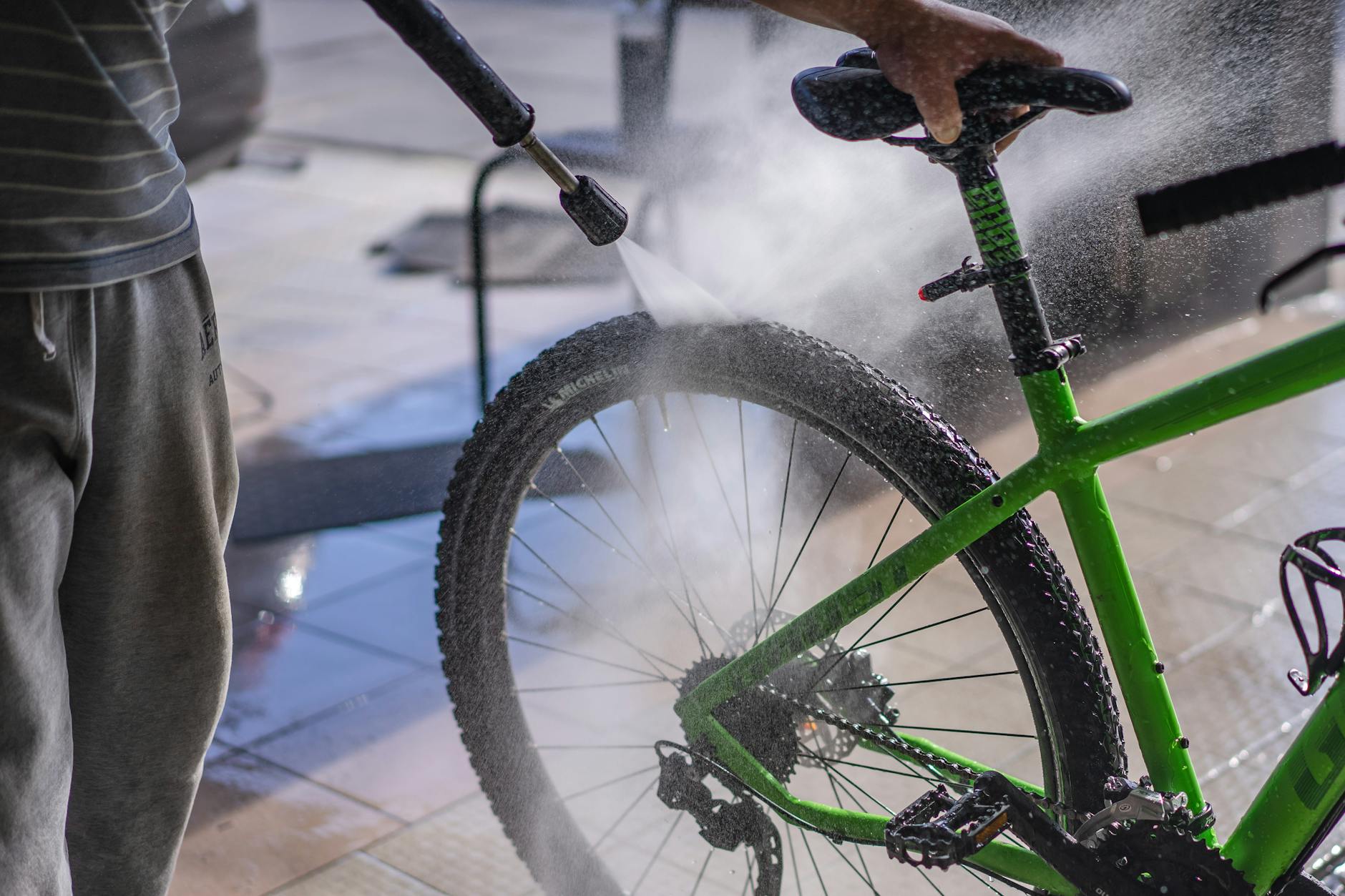
The single most damaging cleaning mistake professionals see is the use of a high-pressure washer aimed at bearing assemblies. Pressurized water forces past seals designed to keep out rain and splash, contaminating the grease inside hubs, headsets, and bottom brackets. Most major bicycle manufacturers explicitly state in their warranty terms that pressure washer damage is not covered. A garden hose with a gentle spray pattern provides more than enough water pressure for bike cleaning. If you visit a professional team’s wash station, you will find garden hose nozzles set to a fan or shower pattern, never a jet. The second most common mistake is applying lubricant to a chain that has not been properly cleaned and dried. Lubricating over old, dirty lube creates a paste that accelerates wear on the chain, cassette, and chainrings simultaneously.
Professionals always degrease, rinse, dry, and then lubricate as distinct steps with time between each one. Applying chain lube to a wet chain is similarly problematic — water dilutes the lubricant and prevents it from penetrating the chain’s rollers where it is actually needed. The professional standard is to allow the chain to air dry completely, or at minimum wipe it thoroughly with a clean rag, before applying any lubricant. A less obvious mistake involves mixing product families in ways that create unexpected reactions. Certain degreasers leave residues that interfere with specific chain lubricants, particularly wax-based lubes. If you use a wax lubricant like Squirt or Smoove, you need to ensure your degreaser removes all previous wet lubricant and that no solvent residue remains before waxing. Some professionals who maintain wax-lubed drivetrains keep an entirely separate set of cleaning tools to prevent cross-contamination from petroleum-based products. This sounds excessive until you have experienced the frustration of a wax application that flakes off after twenty miles because of invisible solvent residue.

The Professional Approach to Carbon Fiber and Electronic Component Cleaning
Carbon fiber frames and electronic shifting systems require adjusted cleaning protocols that not all products accommodate. Harsh solvents can damage the clear coat and UV protection on carbon frames, leading to cosmetic degradation and, in extreme cases, structural concerns from UV exposure over time. Professionals stick to pH-neutral bike washes for carbon frames and avoid any product containing ammonia or strong alkaline compounds. Finish Line Super Bike Wash and Muc-Off Nano Tech Bike Cleaner are both pH-neutral and widely used on professional team carbon frames.
A team mechanic for a WorldTour squad noted that they test any new cleaning product on an inconspicuous area of a retired frame before using it on race bikes — a practice home mechanics with expensive carbon frames would be wise to adopt. Electronic drivetrains from Shimano Di2, SRAM AXS, and Campagnolo EPS are sealed against normal water exposure but should not be subjected to direct high-pressure spray at junction ports or charging contacts. Professionals clean around electronic components with a damp cloth and mild soap rather than spraying them directly. Contact points can be cleaned with isopropyl alcohol on a cotton swab if corrosion begins to appear. The groupset manufacturers design these systems for rain riding, not power washing, and the distinction matters during cleaning.
What the Next Generation of Bike Cleaning Products Looks Like
The bike cleaning product market is shifting toward waterless and low-water formulations driven by drought restrictions in major cycling regions and a growing environmental consciousness among riders. Products like Juice Lubes Dirt Juice Boss and Green Oil Eco Bike Cleaner represent a category that barely existed five years ago — effective cleaners that require only a spray and wipe rather than a full hose-down.
Professional teams competing in water-restricted regions of Australia and Southern California have already incorporated waterless wash products into their regular rotation. These products are not yet a complete replacement for traditional washing on heavily soiled bikes, but their rapid improvement suggests that the full-water wash may eventually become an occasional deep-clean rather than the standard weekly routine. For the home mechanic with limited outdoor space or no hose access, waterless products have already reached a level of effectiveness that makes regular bike maintenance genuinely practical.