Nine times out of ten, a wheel that rubs the brake right after you refit it is simply not seated square in the frame — the axle has not dropped fully into both dropouts, so the rim or rotor sits off-centre. Loosen the quick release or thru-axle, let the bike's weight settle the axle home, and re-tighten before you touch a single brake adjuster. The other common causes are specific and quick to identify: a rim brake whose quick-release lever was reopened, a hydraulic disc brake whose pads closed up because the lever got squeezed with the wheel out, or a caliper that needs re-centring. The sections below work through them in the order a mechanic would, starting with the fixes that cost nothing.
Table of Contents
- Reseat the wheel before you adjust anything
- Read the rubbing pattern
- Rim brakes — the three usual culprits
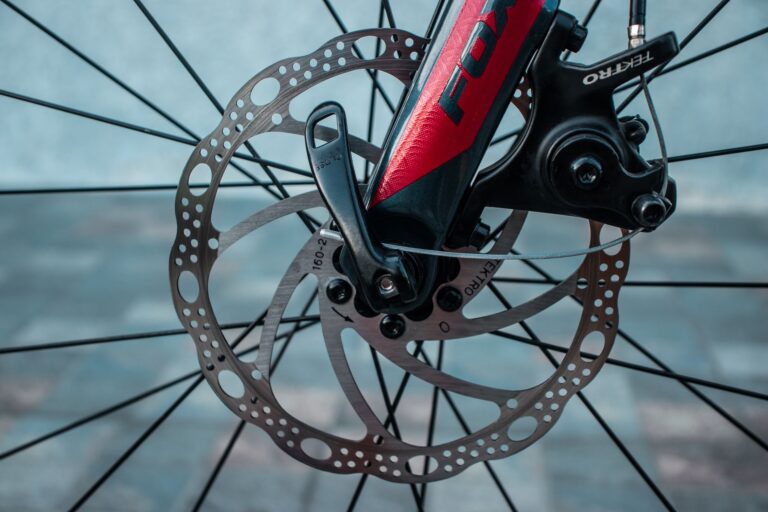
- Disc brakes — rotor, pistons, and caliper position
- When the wheel itself is at fault
- Check these before you ride away
- Frequently Asked Questions
Reseat the wheel before you adjust anything
A wheel is located by its axle sitting flat against the top of both dropouts — the slots or holes in the frame and fork that the axle sits in. If one side is a few millimetres short of home, the whole wheel tilts, and the rim or rotor moves sideways into the brake. Adjusting the brake to suit a crooked wheel only hides the problem and leaves the brake wrong when the wheel is next fitted properly.
Do it this way rather than by eye: Front quick-release forks have raised tabs — often called retention tabs or lawyer lips — around the dropouts. If the quick-release nut is not loosened enough, those tabs stop the axle reaching the bottom of the slot and hold the wheel visibly askew. If the wheel will not drop in without force, back the adjusting nut off another full turn.
- Open the quick release fully, or unscrew the thru-axle a few turns.
- Set the bike on the ground so its weight pushes the axle into the dropouts, or hold the wheel firmly up into them.
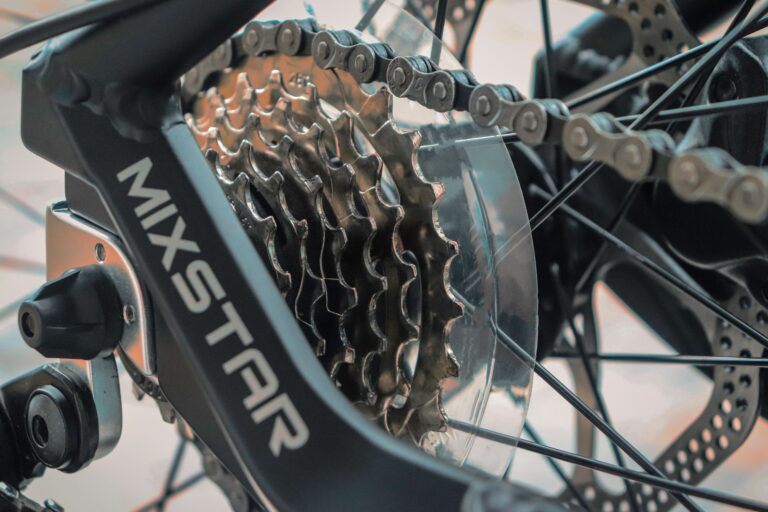
- On a rear wheel, put the chain on the smallest sprocket and pull the derailleur body back so the wheel drops in cleanly.
- Close the quick release or tighten the thru-axle while keeping that upward pressure.
- Spin the wheel and look at the gap on each side of the brake.
Read the rubbing pattern
Where and when it rubs tells you what to fix. Lift the wheel, spin it, and watch and listen for a full revolution or two.
Mark the tyre with a piece of tape at the point of contact if the rub is intermittent. It makes a single high spot much easier to find than trying to watch the whole rim.
- A steady rub all the way round, on one side only: the wheel is off-centre in the frame. Reseat it first, then look at centring the brake.
- A rub that comes and goes once or twice per revolution, at the same spot: the rim is out of true, or the rotor is slightly bent. The wheel position is not the problem.
- A rub on both sides at once: with rim brakes, the pads are set too close; with hydraulic discs, the pistons have advanced and closed the gap.
- A rub that only appears when you pedal hard or stand up: flex, or a loose hub — see Section 5.
Rim brakes — the three usual culprits
Rim brakes carry their own quick release, and it is the first thing to check. On a road caliper it is a small lever on the brake body; on Shimano V-brakes it is the cable noodle that unhooks from the holder; on cantilevers it is the straddle cable. It has to be closed again after the wheel goes in. Left open, the pads sit wide and the brake feels weak; closed onto a wheel that was refitted crooked, the pads land unevenly. If the wheel is seated correctly and the rub is still one-sided, centre the caliper.
Single-pivot and dual-pivot road calipers have a small centring screw on the top or side — a quarter turn moves the whole caliper across. V-brakes and cantilevers have a spring tension screw at the base of each arm: tighten the screw on the side the pads are rubbing, or loosen the one on the opposite side, in small increments. Check the pads themselves while you are there. A pad should contact the braking surface of the rim squarely, not overhanging the top edge into the tyre, and not dipping below the rim where it can catch nothing at all. A pad rubbing the tyre sidewall will cut through it, so treat that as urgent rather than annoying.
Disc brakes — rotor, pistons, and caliper position
The rotor is a thin steel disc, and it passes through a gap of roughly the thickness of a coin. Very small errors show up as noise. Reseat the wheel first, exactly as in Section 1, because a disc wheel that sits a fraction low in the dropouts will drag every time. If you squeezed the brake lever while the wheel was out, the hydraulic pistons will have advanced and the pads will have closed together — sometimes far enough that the rotor will not fit back in at all.
The fix is to push the pistons back into the caliper gently and evenly, using a plastic tyre lever or a dedicated pad spreader, never a screwdriver against the pad face. Refit the wheel, then pump the lever a few times to bring the pads back to their working position. If the rotor is centred but the caliper is not, realign it: That trick relies on both pistons moving, so it works well on hydraulics and poorly on mechanical (cable-pull) disc brakes, where usually only one pad moves. Mechanical calipers are aligned by eye instead: set the fixed pad close to the rotor with its adjuster, then position the caliper so the rotor sits just clear of it.
- Loosen the two caliper mounting bolts about half a turn each, so the caliper can slide.
- Squeeze and hold the brake lever firmly — this pulls the caliper into line with the rotor.
- Tighten the bolts alternately, a little at a time, while still holding the lever.
- Release, spin, and check. Repeat if it still touches.
When the wheel itself is at fault
If the rub survives a correct reseat and a centred brake, the wheel is the variable. Spin it and sight the rim against the brake pads: a rim that wanders side to side needs truing, which means adjusting spoke tension with a spoke key, quarter turn at a time, pulling the rim towards the loose side. Hub bearings matter too. Hold the top of the tyre and rock it side to side across the frame.
Any knock you can feel there means the hub is loose or worn, and a loose hub lets the rim swing into the brake under load even when it looks fine at rest. On a disc bike, the same play shows up as a rub that appears only when you pedal hard or corner. A bent rotor is common after transport or a fall, and it is usually one visible wobble rather than a general wander. It can be straightened carefully with a rotor truing fork, bending a little and rechecking often. Handle rotors by the spokes or with a rag, because oil from your fingers on the braking surface causes squeal and lost power.
Check these before you ride away
A wheel that has been off is a wheel that can come off. Give it thirty seconds before you get back on: If the rub is disc brake noise that appears only occasionally and the brake stops the bike properly, it is very often cosmetic and safe to live with. Rim brake rubbing is not, because it means the pad position is wrong — and a pad in the wrong place is one that can climb into a tyre sidewall or drop off the rim under braking.
- The quick-release lever should need real force to close with your palm, and should leave a brief mark on your hand. If it flips shut with two fingers, it is too loose — open it, tighten the nut on the far side, and close it again.
- The lever should end up tucked along the fork leg or seatstay, never pointing forwards where it can be caught or levered open.
- A thru-axle should be fully threaded in and snug; if you have a torque wrench, use the figure printed on the axle or the frame.
- Lift the front of the bike and drop it a few centimetres. Rattles mean something is loose.
- Squeeze each brake lever hard before moving off, and confirm it stops firm rather than pulling to the bar.
Frequently Asked Questions
Why does the rub only happen when I pedal hard?
That is flex under load, and it usually points at a loose hub bearing or a wheel with uneven spoke tension rather than at the brake. Rock the top of the tyre sideways in the frame; any knock means the hub needs attention.
Can I just move the brake over to stop the noise?
Only once the wheel is properly seated. If you centre the brake around a crooked wheel, the brake will be wrong the next time the wheel goes in straight, and the pad may sit too high or too low on the rim.
The rotor will not fit back between the pads at all. What happened?
The brake lever was squeezed while the wheel was out, which pushed the hydraulic pistons forward and closed the gap. Spread the pads apart gently with a plastic tyre lever or a pad spreader, refit the wheel, then pump the lever to reset them.
Is a small amount of disc brake rub normal?
A faint intermittent tick from a disc is common and generally harmless if braking power is unaffected. Constant dragging that slows the wheel noticeably is worth fixing, because it wears pads and rotors faster.